
Closure orders: calculating units and cartons, checking pallet details
Calculate your order quantity without confusing the units per carton with the loading table, and clarify the quotation unit, packing arrangement and delivery scope.
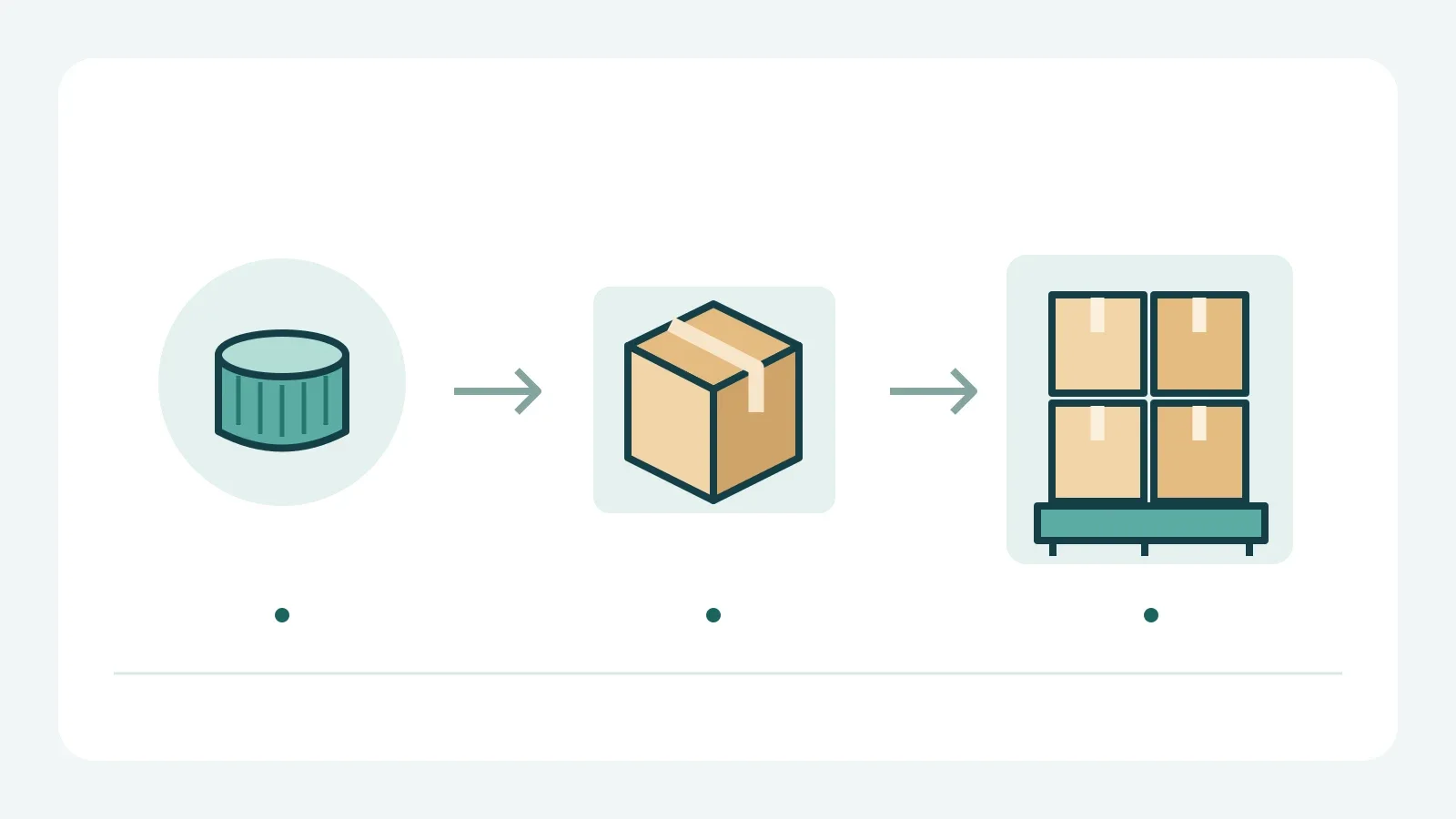
What exactly does “unit” count in the quotation?
If one quotation is per unit and another is per carton, do not compare the prices directly. First check that both refer to the same product code and variant, counting unit and order quantity. For a product with multiple parts, does “unit” mean a single component or a complete set? What counting unit does the quantity per carton refer to? Do not convert component counts into an order quantity until you have written answers to both questions.
GS1’s packaging hierarchy approach also defines the unit, case and pallet as separate levels, with the contents of each higher level specified. This distinction is a useful check when comparing quotations. No claim is made here that any Peksan product has a GTIN registration or complies with a particular pallet standard.
Calculate the number of cartons first
For the same counting unit agreed with the supplier, the basic calculation is: total order quantity = number of cartons × quantity per carton. For example, on 4 October 2026, the 011.031CWF11N product page lists 6,000 units per carton and carton dimensions of 40 × 60 × 40 cm. Using the same counting unit, 10 full cartons correspond to 60,000 units. This is an arithmetic example based on published packing information, not a price quotation or a commitment to stock availability.
If you need 65,000 units and orders are limited to full cartons, you need 11 cartons, or 66,000 units. Ask separately whether partial cartons are allowed; rounding up to 11 cartons is not a supplier minimum order requirement. For the two-part 011.031CWF11N, do not automatically interpret the figure of 6,000 as 12,000 separate components or 6,000 assembled sets; confirm what is counted and what is supplied under the quotation.
Check the unit used in the loading table
The loading matrix description on the 011.031CWF11N page states that capacities are given as numbers of cartons. It is therefore incorrect to use a value in a vehicle column directly as a number of caps. Read the selected palletised or non-palletised row together with its carton count. A dash in a cell does not mean zero capacity; it means no capacity is specified for that option.
Converting the number of cartons into a piece count is one task; approving the pallet arrangement or vehicle capacity is another. The pallet footprint, loaded height, gross weight, stacking conditions and carrier restrictions must be verified for the order. Do not apply another product’s carton dimensions or pallet arrangement to this product.
Calculate volume without treating it as a freight charge
The geometric volume of a 40 × 60 × 40 cm carton is 0.40 × 0.60 × 0.40 = 0.096 m³; for 10 cartons, it is 0.96 m³. This calculation excludes pallets, gaps and protective packaging. Request the shipment’s measured external dimensions, gross weight and the carrier’s charging basis separately. Geometric carton volume alone does not determine the freight charge or the quantity that will fit in a vehicle.
Compare quotations with the same delivery scope
In your comparison, keep separate fields for the product code/variant, whether the price is per unit or per carton, quantity per carton, total quantity, currency, tax coverage, packaging/pallet charges, transport scope, delivery location and quotation validity. When comparing a product price per thousand units with a carton price, first convert them to the same unit; do not add separately priced items twice.
According to ICC, Incoterms® rules allocate delivery-related obligations, costs and risks. If they are used, state the rule, named place and edition clearly. Incoterms® 2020 does not replace payment terms or the technical product specification. Do not rank two totals with unclear delivery scopes as though they include the same service.
A short record to include with your request for quotation
Complete these fields: full product code and colour/variant; definition of the counting unit; required quantity; preference for full or partial cartons; quantity per carton and external dimensions; pallet arrangement and gross weight, if applicable; delivery address and requested date; specific questions about pricing and delivery scope. Also attach the current technical data sheet and the relevant drawing revision.
When sending Peksan a quotation or sample request for 011.031CWF11N, describe your application and packaging structure, and confirm what the counting unit covers. A correct packing calculation is not approval of technical compatibility; complete the sample and production order records separately. This can prevent different contents from being priced under the same word, “unit”.
Sources and related guides
- GS1 Sweden — Base unit, case and pallet levels
- ICC — Incoterms® rules
- ICC — Introduction to Incoterms® 2020
- 011.031CWF11N technical data sheet
- From sample approval to production order