
How do you select flip-top and snap-on closures?
A hinge is different from bottle attachment
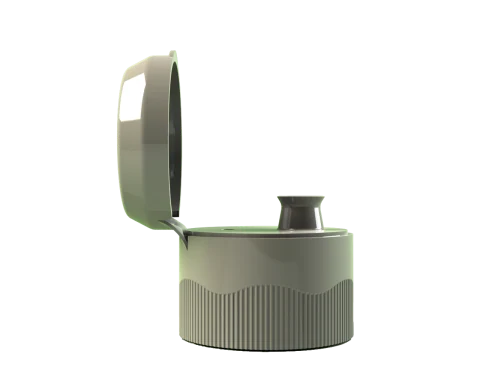
A flip-top closure has an upper section that opens on a hinge. This name alone does not identify how the body attaches to the bottle. It may use a screw or snap-on connection. Users can access the product by opening the upper section, but dispensing, reclosure and first-opening features depend on the model. Not every flip-top closure suits the same bottle or formulation.
Screw and snap-on options
Screw attachment requires matching thread geometry; snap-on attachment requires matching seating and engagement surfaces. The catalogue identifies 028.026CTP10B as a flip-top screw closure and 038.027CSP12B as a flip-top snap-on PET bottle closure. Changing between these designs is not simply a matter of choosing another diameter. Assess the bottle neck drawing and complete product code together.
Snap-on attachment does not establish suitability for carbonated products or mean that the cap automatically opens when pressed by the user. Application on a filling line and consumer opening are separate actions.
What does the number of parts tell you?
Part count describes construction, rather than independently establishing quality or cost. Peksan lists 032.012CSP10B as a 32 mm single-piece snap-on PET bottle closure with a tear-off band. Sharing a nominal size with a two-piece design does not establish equal performance or direct substitution. Fewer parts also do not automatically demonstrate a lower environmental impact in every application.
Check opening and dispensing on samples
Assess hinge movement, upper-lid closing, dispensing behaviour and product remaining around the opening using the actual formulation. Define conditions for sealing, transport and filling-line feeding trials beforehand. Testing with water may not represent a product with different flow properties.
Provide the bottle drawing, actual product, filling conditions and intended opening action when requesting a quotation. Verify colour, construction, foil or liner options and tamper-evident features for the complete product code. Membership of a catalogue family does not mean that every desired combination of features is available.
Related products
Related guides
Glass bottle caps and stoppers: selection and design
How are plastic closure design and production planned?
How should closure prices and production costs be assessed?
How should closure materials, quality and recycling be assessed?
How should drum and water-container closures be selected?
How should bottle, water-container and jar handles be assessed?
What is a protective cover for a food can, and how is it selected?
How are plastic bottle production and closure fit assessed?
Empty bottle and container prices: requesting a 1 or 5 litre quotation
Plastic bottle types: assessing PET, PE and PS
Cosmetic closures: disc-top, roll-on and powder formats
Are foil seals, tamper evidence and child resistance the same?